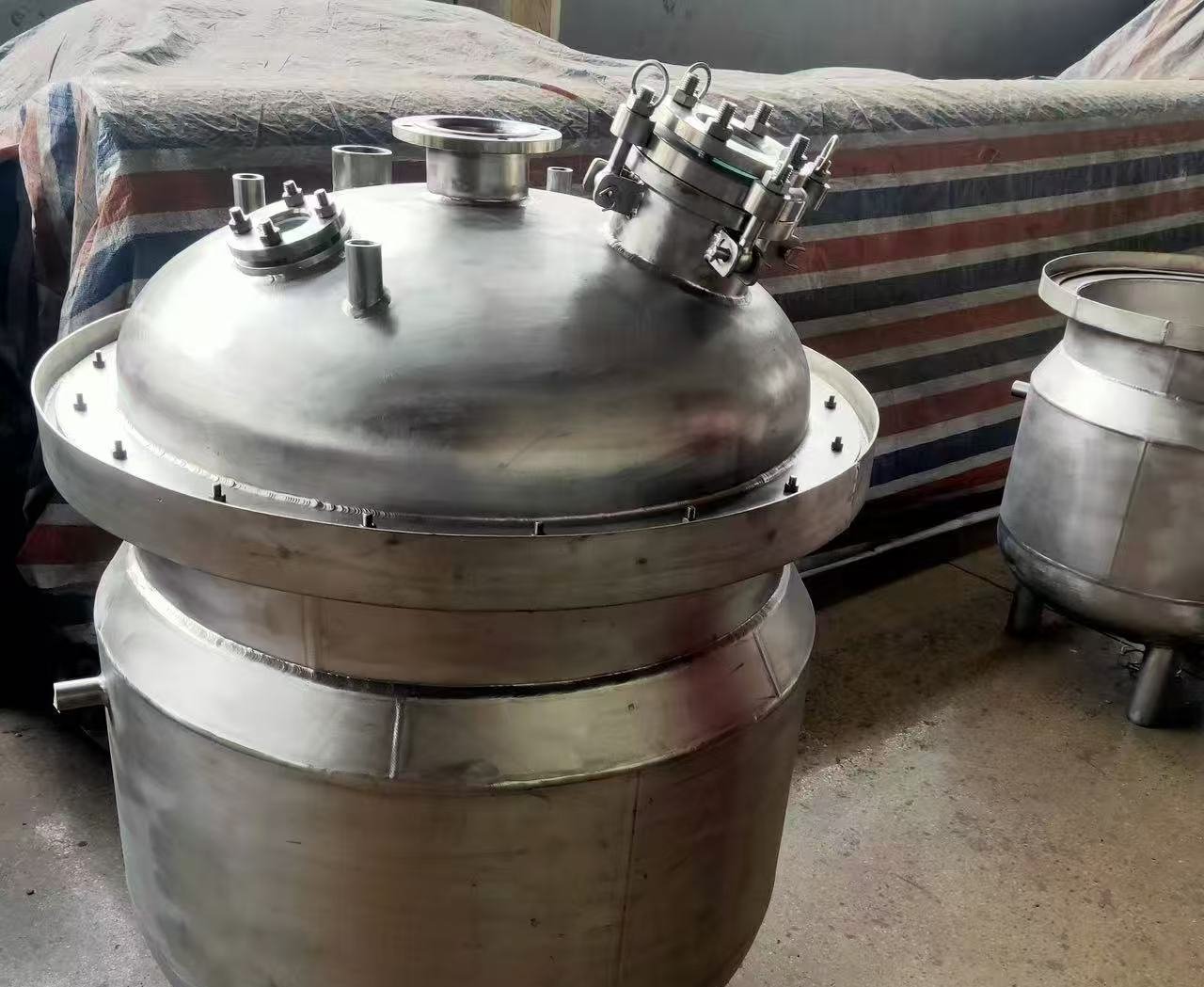
A glass-lined reactor needs an internal visual inspection and a high-voltage lining test every six months, and a chip of exposed enamel under about 10 cm² on a low-wear, non-sealing surface can usually be repaired in place with a PTFE plug, a tantalum patch or a silicate repair compound. Damage on a gasket land, an agitator shaft or a baffle root, or any defect that fails the high-voltage test, cannot be patched: the vessel is re-lined or replaced. A new 3,000 L jacketed glass-lined reactor from China costs USD 8,000–14,000 ex-works, which is the number every repair decision should be measured against.
1. The inspection interval and what it covers
Six months is the working interval for an internal inspection, with a monthly external walk-around in between. If the vessel runs corrosive media, cycles temperature, or handles an abrasive solid, halve it. The inspection has four parts, and skipping the third is how plants discover a leaking seal only after the lining behind it has gone.
- Lining, visual. Chips, crazing, dark spots where steel shows through, rust blooms around nozzle roots. A rust stain on glass is a hole with a witness.
- Lining, electrical. The high-voltage (spark) test finds pinholes that a torch and an eye miss. Test at the kV figure recorded on your specification confirmation sheet — the value the vessel was accepted at, not whatever the local workshop has to hand.
- Sealing surfaces. Manway gasket land, nozzle faces, the agitator shaft in way of the mechanical seal, the seal seat. A chip here is not a chip, it is a leak path.
- Agitator and drive. Shaft run-out, impeller condition, coupling, seal faces, lubricant. A shaft that vibrates will destroy a lining faster than most chemistries will.
2. What actually damages a lining
Four mechanisms, and three of them are operating error rather than manufacturing fault.
- Mechanical impact. A dropped spanner, a charge thrown in through the manway, an over-tightened clamp, hydro-blasting during cleaning. Glass fails in tension; a point load is enough.
- Thermal shock. The stated resistance is a cold shock of ≤ 110 °C and a heat shock of ≤ 120 °C, expressed as the temperature difference between the charge and the wall, not the operating temperature itself. Pumping cold solvent into a hot vessel is the classic way to craze a lining.
- Chemical attack. Glass lining is not universal. It is not suitable for hydrofluoric acid or fluoride-bearing media, for phosphoric acid at ≥ 30 % concentration above 180 °C, or for strong alkali above pH 12 at 100 °C. If the process drifts into that envelope, no repair will hold.
- Stress at discontinuities. Nozzle roots, baffle welds, the knuckle, and the bottom head directly under the impeller. Crazing starts where the steel flexes.
3. Can a small chip be patched? Three questions, in order
Where is it, how big is it, and does it pass the spark test afterwards. If any of the three answers is wrong, the repair is cosmetic and the file should say so.
Where. A chip in the vapour space, on the upper shell, or on a baffle face away from the seal is a repair candidate. A chip on a gasket land, an agitator shaft, a baffle root, a nozzle sealing face or the bottom head under the impeller is not — those areas carry load, movement or a seal, and a patch there fails at the wrong moment.
How big and how deep. Under roughly 10 cm² with bare steel visible and no undercutting at the edge, repair is normal practice. Larger than that, or a cluster of chips spread across one area, and the lining is telling you it is at end of life. Depth matters as much as area: a chip down to bright steel is a corrosion cell, a surface flake that has not exposed metal is cosmetic.
Does it pass afterwards. The repaired area is re-tested at the same kV. If it arcs, the job is not finished. Note in the file that a compound fill has no dielectric strength comparable to fired enamel, so the test proves the patch boundary is sound, not that the patch is glass.
The three repair methods used in practice:
- PTFE plug. A tapered plug set into the chip, tapped or cemented, used on non-sealing surfaces. Fast, removable, and it does not restore the surface profile.
- Tantalum patch. A thin tantalum sheet fixed over the damaged area for acid service where the plug material would not survive. Better chemical resistance, more work to fit, and it must not obstruct the agitator sweep.
- Silicate repair compound. A two-part filled silicate for building a chip back flush with the surrounding glass. Suited to product-contact surfaces where flow matters; it cures rather than fires, so treat its life as finite and re-check it at every inspection.
Record every repair: position with a photograph and a scale in the frame, area in cm², method, material, date and kV result. A patch with no record is an unknown at the next inspection and a finding at the next audit.
4. When the vessel should be replaced, not repaired
- The defect sits on a sealing face, a shaft, a baffle root or a nozzle thread.
- Spark-test failures are scattered across a head rather than localised at one chip. That pattern means end of lining life, not a repair job.
- Steel is corroding under the damage. Rust weeping from a chip means the media has already reached the substrate, and a plug stops mechanical loss but not that corrosion.
- The process runs outside the media envelope, particularly fluoride or strong alkali. Patching a lining the chemistry is actively attacking buys months.
- The vessel has already been re-lined once. A second re-line rarely reaches the life of the first.
5. The cost comparison, with the numbers you have
The anchor is the replacement price: a 3,000 L jacketed glass-lined reactor with a mechanical seal, USD 8,000–14,000 ex-works China, with the spread driven by the seal arrangement, the jacket type and the agitator. A plug or a patch is small money against that and is almost always the right first move.
Re-lining is the case that needs arithmetic. Ask for the quote with both freight legs, the re-test, a new gasket set and your downtime in the number, then compare it with a new vessel line by line rather than against the repair alone. Where the two land within a few thousand dollars of each other, the new vessel carries a fresh warranty and a full remaining life that the re-lined shell does not.
Replacement also does not have to be like-for-like. If the old vessel was specified for a duty you no longer run, re-specify the seal, the agitator and the jacket heat-transfer area on the replacement order, and carry the maintenance history across to the new file.
6. What to do next
- Write the six-month internal inspection into the maintenance plan with the kV figure from the specification confirmation sheet, the lining thickness and the media envelope printed on the same page.
- Photograph every inspection with a scale in frame. Size arguments disappear when the picture has a ruler in it.
- Fix your own repair limit in writing before the first chip: the 10 cm² area rule, the excluded zones, and who signs off a patch.
- Request a replacement quotation while the vessel is still healthy. It costs nothing and turns the next repair decision from a crisis into a comparison.