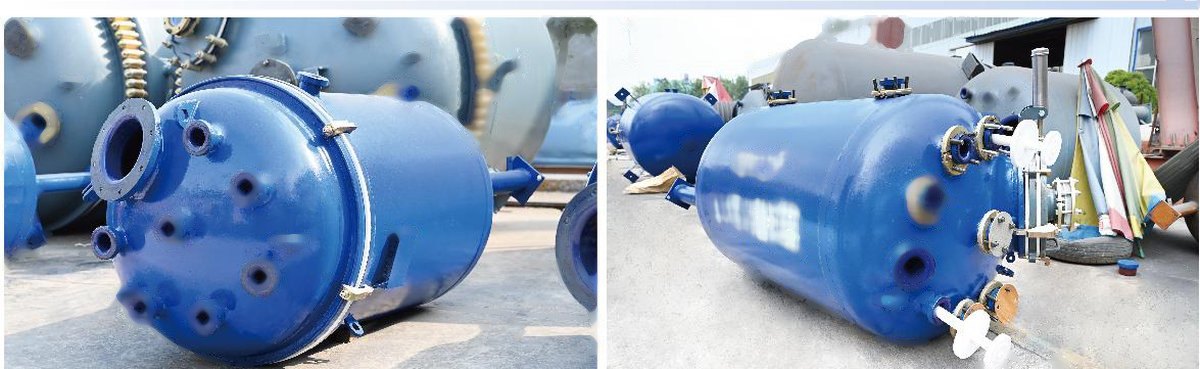
Glass-lined reactor thermal shock limits in practice
Cold shock ≤ 110 °C and heat shock ≤ 120 °C are guarantees, not guidelines. Here is what each number protects, where plants break it, and how to keep the lining intact.
Read more →
You need glass-lined or stainless steel reactors. What you don't need is five factories, two forwarders, a language you don't speak and a container that sails before anyone checks it. We source, verify, inspect and ship — and stay accountable until the vessel is running in your plant.
Buying a pressure vessel from 8,000 km away is a risk problem, not a product problem. This is what we take off your desk.
We concentrate on reaction vessels, because that is where the money and the risk sit. Every unit is available as a full custom build.

Steel shell, vitreous glass lining fired at 850–950 °C. The workhorse of API synthesis, fine chemicals, agrochemicals and dyes. We set the lining thickness, jacket type and seal against your actual medium.
Details →
For high-purity, high-pressure and caustic duty where glass lining is the wrong answer. Mirror-polished internals, jacket or coil heating, six agitator options, full automation packages.
Details →
Steel carries the pressure, fluoropolymer carries the chemistry. The answer for fluoride media, strong oxidisers and ultra-high-purity work — non-scaling, non-fouling, no ion contamination.
Details →A short, predictable process — you always know what happens next and what it costs.
Send the duty: medium, concentration, temperature, pressure, volume, destination. If you don't know the numbers yet, we work them out with you.
You receive a fixed specification and a line-by-line quotation. Configuration, materials, testing, packing and freight shown separately — no hidden extras.
Production starts, we monitor it, and you get pictures and test records as it moves. Nothing ships unverified.
Crating, customs, documents, freight. After arrival: drawings, spare parts and commissioning help from the same person who sold it to you.
Almost every glass-lined reactor exported from China comes out of one small cluster of workshops around Zibo. Sitting in the middle of it is the only real advantage an agent can offer.

Short, specific answers to the questions that decide whether an order goes right. If one guide here saves you a bad shipment, it did its job.
Cold shock ≤ 110 °C and heat shock ≤ 120 °C are guarantees, not guidelines. Here is what each number protects, where plants break it, and how to keep the lining intact.
Read more →A pre-shipment inspection is not a single report. Here are the 12 checks we walk through before a glass-lined, stainless or PTFE-lined reactor leaves China.
Read more →A 20 kV spark test finds pinholes that reach the steel. It says nothing about lining thickness, adhesion or chemical resistance — and without a serial-numbered record, nothing at all.
Read more →A plain jacket, a half-pipe coil and a dimple jacket differ on heat flux, pressure, cost and how close you can put two vessels. Here is how to pick, point by point.
Read more →The same 3,000 litre reactor can be quoted at $4,000 or $12,000, and both prices can be defensible. Here is what actually moves the number — and what to ask before you accept either.
Read more →The choice is decided by chemistry, not by budget. Here is where each material wins, and the specific conditions where the wrong choice becomes an expensive warranty dispute.
Read more →Most failed orders were visible months before shipment. Five checks — most of them free — catch the majority of them before money moves.
Read more →No obligation and no sales sequence. Tell us what you are trying to make, and we will tell you what it takes — vessel, material, limits and price.